
Longevity NotesLongevity Notes · No. 4 · Back to the Root

PRP for hair loss: results, sessions and what it costs

Platelet-rich plasma is among the most searched treatments for thinning hair. What the studies show, how many sessions you need, when the result shows and what it costs.

By the KinAura medical team21 November 20264 min read

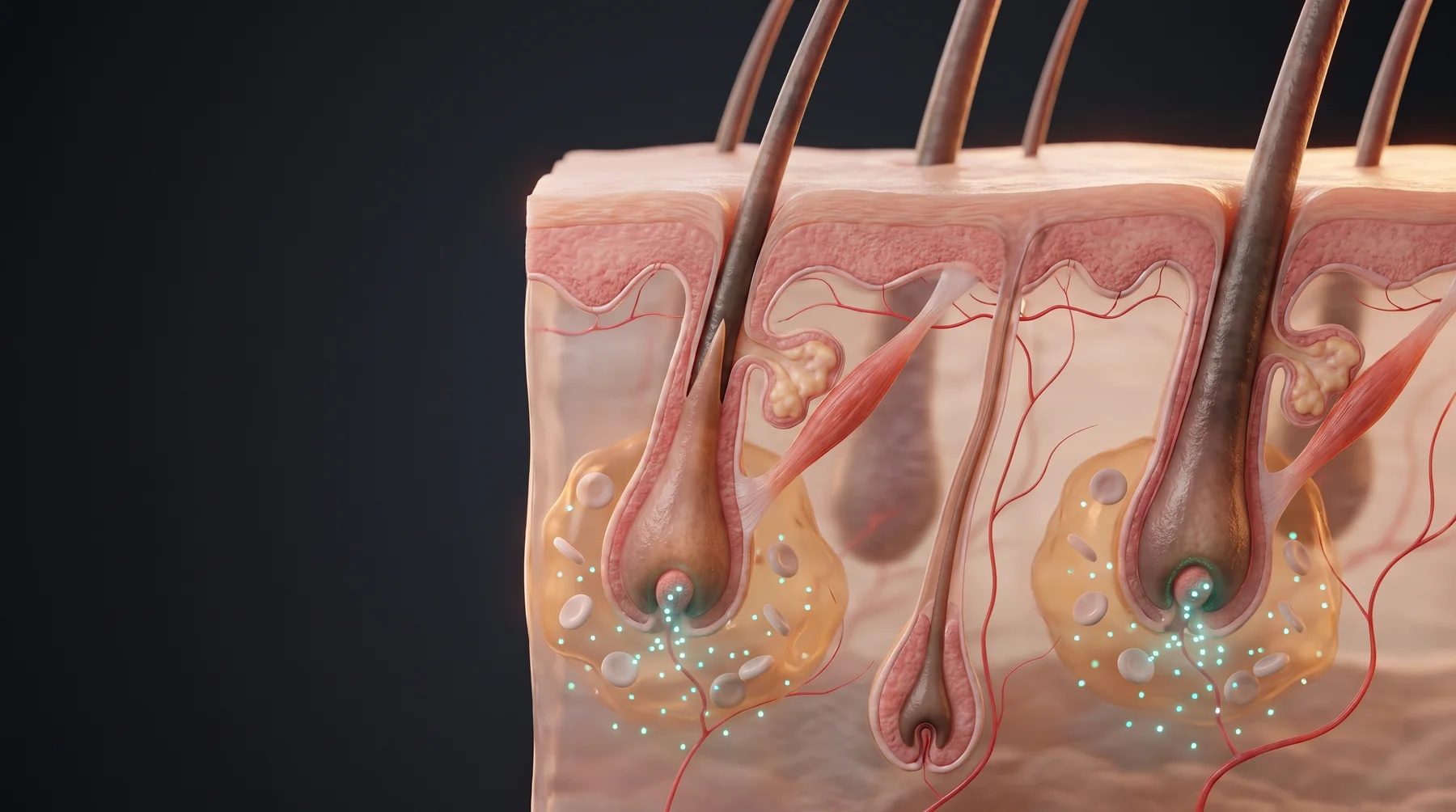
Scientific 3D rendering of the scalp in cross-section: hair follicles with sebaceous glands and platelets releasing growth factors near the papilla
Concentrated platelets bring growth factors to the bulb and wake up the follicle.

This post is also available in: Italiano (Italian)

What PRP for hair is

PRP stands for platelet-rich plasma. It is obtained from a small sample of your own blood, which is centrifuged to separate and concentrate the platelets. Platelets contain growth factors and other molecules that take part in tissue repair.

Injected into the scalp, PRP brings these molecules close to the bulb. In laboratory studies they support the survival of follicle cells, the formation of small vessels and a longer growth phase of the hair.

Who it is for

The most studied indication is androgenetic alopecia, the most common form of thinning in both men and women. In women it usually shows as diffuse thinning on the crown, with a widening parting.

Thinning starts in the follicle, which shrinks and produces finer and finer hair. PRP works right there, on follicles that are still alive. That is why it does best when you start early, at the first signs: a widening parting, more hair on the brush, a crown that shows more in photos.

What the studies show

One of the most cited studies is Italian. At the University of Rome Tor Vergata, researchers treated half the scalp of men with androgenetic alopecia with PRP and the other half with placebo, without the evaluator knowing which was which. After three sessions a month apart, on the treated side density had increased by an average of almost 46 hairs per square centimetre from baseline.

+46Hairs per square centimetre gained from baseline on the side treated with PRP, after three sessions, in a randomised placebo-controlled study.

Meta-analyses, which pool many studies, confirm the result. Across nine randomised trials PRP increased hair density at three and six months compared with placebo. A larger analysis of 43 randomised trials found more density and less shedding, with good patient satisfaction.

PRP also works well as part of a team. In meta-analyses, adding PRP to minoxidil gave more density than minoxidil alone. Head to head, PRP gave density similar to minoxidil with a few sessions in place of a daily application.

How many sessions and when you see it

A course is three or four sessions, one every four weeks. Hair grows at its own pace: first changes show around the third month and the result is measured properly at six. After that a top-up session is enough, at KinAura usually every six months.

The session is short. After the blood sample and the preparation of the plasma, the doctor makes small injections into the scalp. It is well tolerated and you go straight back to your day.

PRP at KinAura

In clinic we prepare PRP with a system that concentrates platelets up to 12 times more than standard PRP: more platelets at the follicle, in every session. It is always performed by a doctor, at Via Sant’Andrea 21, in Milan’s fashion district.

12XUp to 12 times more concentrated than standard PRP: more platelets at the follicle, in every session.

In Italy PRP is classed as a blood component for non-transfusion use. Outside hospitals it can only be prepared by facilities that hold an agreement with a Transfusion Service. KinAura holds this agreement.

How much PRP for hair costs

At KinAura a PRP session starts from €500. You book it directly, with no preliminary consultation: choose the day and come to the clinic. If you would rather talk to the doctor first, the consultation is free.

The earlier you start, the better it works

PRP has solid data on androgenetic alopecia and does best at the first signs of thinning. Three or four sessions, a doctor who follows you over time and a top-up every six months.

FAQ

PRP for hair, the questions we hear most

Does PRP for hair work?

Yes. In androgenetic alopecia, meta-analyses of randomised trials have shown more hair density and less shedding than placebo.

How many PRP sessions do I need for hair?

A course of three or four sessions, one every four weeks. After that a top-up session is enough, at KinAura usually every six months.

How much does PRP for hair cost?

At KinAura a PRP session starts from €500. The course is three or four sessions, one every four weeks.

When will I see PRP results?

Hair grows at its own pace: first changes show around the third month and the result is measured properly at six months.

How long does the PRP result last?

The result is maintained with a top-up session. At KinAura, after the first course, the top-up is usually every six months.

Does PRP work for women too?

Yes. Female androgenetic thinning, with a widening parting, is one of the most studied indications.

Is PRP painful?

Small injections are made into the scalp. It is well tolerated and can be eased with cooling or local anaesthetic. You go straight back to your day.

Do I need a consultation before PRP?

PRP is booked directly. If you would rather talk to the doctor first, the consultation is free.

Scientific sources
  1. Bertoli MJ, Sadoughifar R, Schwartz RA, et al. Female pattern hair loss: A comprehensive review. Dermatol Ther. 2020;33(6):e14055. doi:10.1111/dth.14055
  2. Paichitrojjana A, Paichitrojjana A. Platelet Rich Plasma and Its Use in Hair Regrowth: A Review. Drug Des Devel Ther. 2022;16:635-645. doi:10.2147/DDDT.S356858
  3. Gentile P, Garcovich S, Bielli A, et al. The Effect of Platelet-Rich Plasma in Hair Regrowth: A Randomized Placebo-Controlled Trial. Stem Cells Transl Med. 2015;4(11):1317-23. doi:10.5966/sctm.2015-0107
  4. Zhang X, Ji Y, Zhou M, et al. Platelet-Rich Plasma for Androgenetic Alopecia: A Systematic Review and Meta-Analysis of Randomized Controlled Trials. J Cutan Med Surg. 2023;27(5):504-508. doi:10.1177/12034754231191461
  5. Anitua E, Tierno R, Alkhraisat MH. Platelet-Rich Plasma in the Management of Alopecia: A Systematic Review and Meta-Analysis of Clinical Evidence. Dermatol Ther (Heidelb). 2025;15(11):3213-3252. doi:10.1007/s13555-025-01542-8
  6. Umar M, Anwar A, Shamim L, et al. Comparative Efficacy and Safety of Platelet Rich Plasma (PRP) versus Topical Minoxidil for Androgenetic Alopecia: A Systematic Review and Meta-analysis. Aesthetic Plast Surg. 2026;50(3):1340-1353. doi:10.1007/s00266-025-05394-7
  7. Yao J, Zhu L, Pan M, et al. The additive value of platelet-rich plasma to topical Minoxidil in the treatment of androgenetic alopecia: A systematic review and meta-analysis. PLoS One. 2024;19(8):e0308986. doi:10.1371/journal.pone.0308986
The KinAura letter

Get the next issue

An occasional letter in your inbox. No loud promotions, unsubscribe with one click.

Sofa and red maple tree in the KinAura lounge

Join the Circle

The KinAura Circle
An invitation to join our community.

You’ll be the first to receive invitations to our private events in Milan’s Quadrilatero, and occasional previews of the new pathways and protocols we introduce in the clinic. We write rarely, and only when it matters.

Your inbox will stay quiet.